


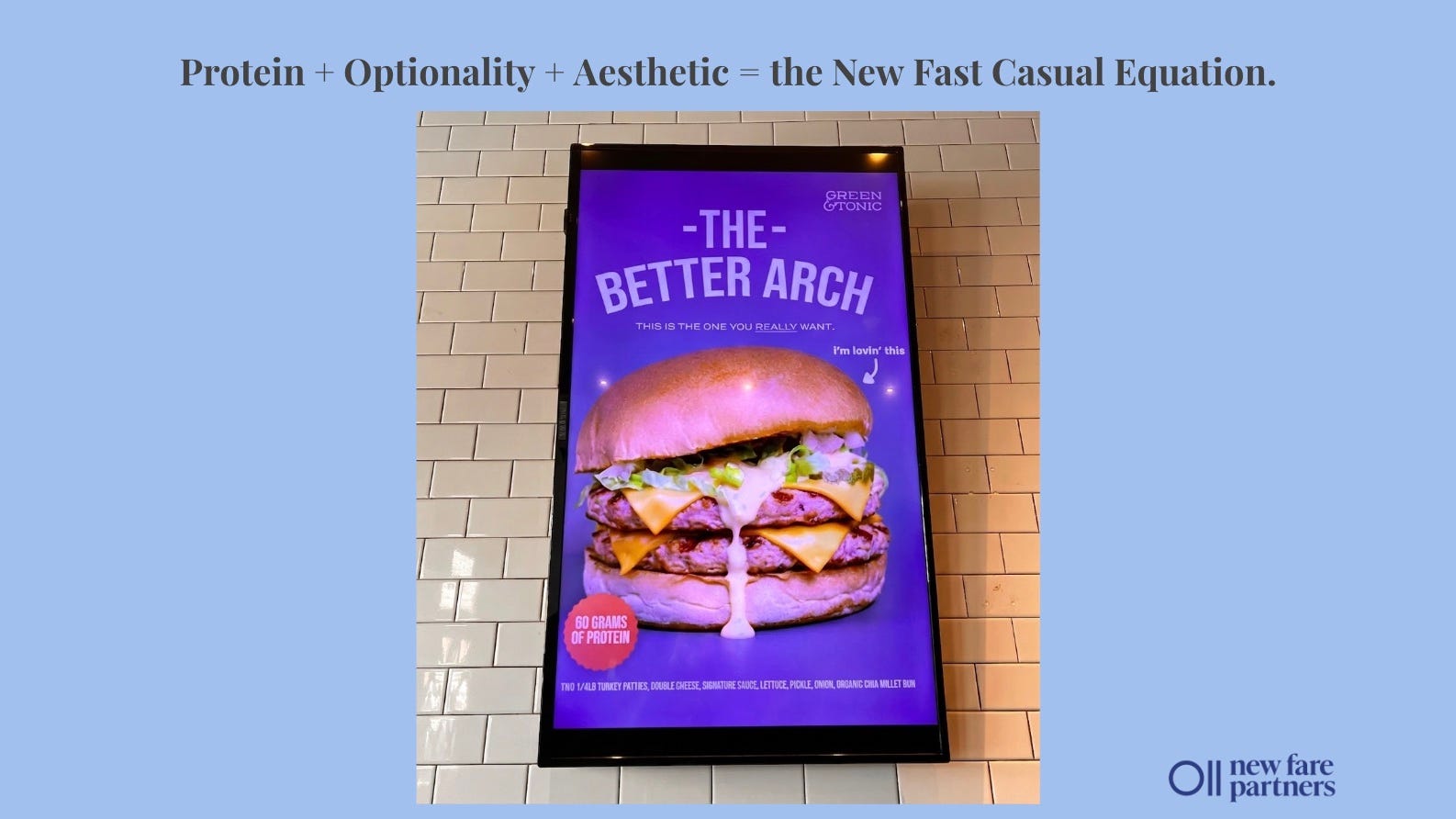
On a recent visit to Connecticut, I was surprised to see what looked like a glossy version of the McDonald’s arch burger being touted from a screen at Green & Tonic (once a vegan hot spot). The display headline: “The Better Arch”. A number of McDonald’s references later, I found very small font at the bottom of the menu listing what this monster sandwich stacks up: 2 turkey patties, double cheese, special sauce, lettuce, pickle, on an organic millet chia bun. The largest callout, naturally, is a major red starburst bottom left promoting 60g of protein.
This ad struck me for a few reasons. Green & Tonic was for over a decade a vegan juice and grab n go cafe. So two cheesy, meaty stacks next to the menu board was a surprise. But even more shocking was the self reference to McDonald’s. This type of 4-wall was for so many years essentially marketing itself as the antithesis of fast food, and more certainly touting the virtues of plant-based eating.
Around the same time, a Pura Vida Miami opened in my neighborhood (Dumbo, Brooklyn). I’ve been there more times than I’d like to admit since its debut a week ago, enjoying the menu as much as the bright, coastal space. I’ve been to Pura Vida in Florida and Manhattan over the years but the proximity and frequency this week has me studying the food, its presentation, and its marketed philosophy even more closely. “Health is happiness” is their tagline. But beyond that, it’s surprisingly difficult to pinpoint what specific standards underpin the menu. The language leans broad: clean ingredients, high quality, food you’d feed your family.
Similarly Green & Tonic “is committed to making craveable food healthy and delicious. Founded in 2012, G&T has evolved to meet the health goals and taste buds of its community”, according to its website. This is reflected in the concept’s food offerings which still include plenty of plant-based “collard wraps”, buddha bowls, and chia puddings, now accompanied by chicken salad and turkey burgers.
In both cases, the signal is clear even if the details are not, and fairly emblematic of today’s fast casual consumer appeal. Less is more in messaging. And … trust us.
The value prop is built on breadth, consumer choice, (animal and plant) protein, and typically clad with a beautiful aesthetic. Now, by offering a menu boasting high protein counts and building a premium experience - digitally, and in person - you’re offering the right combination of signals that “this place is healthy”.
The level of healthy of course is debatable. Pura Vida has been called out for its tuna sandwich carrying 145 grams of fat and sodium levels pushing 3,000 mg – dwarfing the amounts in a McDonald’s Big Mac, with 34 grams of fat and 1,060 mg of sodium. This hasn’t slowed the chain down. Pura Vida has grown to 40+ locations since its founding 2012, and seen 66%+ increase in foot traffic YoY from Feb 2024 to 2025 according to Placer ai. The appeal can’t be denied. There’s a feeling of simplicity and optionality that’s well taken in reaction to decades of limitation and preaching.
To go back, from the early 1990s through the mid-2010s, it’s important to be reminded that the trailblazers in food were focused on quality, and more specifically, where that quality began. Not just ingredients in the abstract, but sourcing, supply chains, and the conditions under which food was grown, raised, and prepared. This was the era of Michael Pollan’s The Omnivore’s Dilemma (published 2006) and FOOD Inc. (released in 2009).
A few companies made that legible in a way that hadn’t really existed before. Chipotle Mexican Grill, which I still think of as one of the earliest and most influential, didn’t just improve fast food - it introduced the idea that a scaled restaurant concept could talk openly about farms, animal welfare, and ingredient integrity, and that customers might actually care. Chipotle started as a single restaurant in 1993, growing to 500 locations by its 2006 IPO. Since then, it has scaled to about 4,000 restaurants and over $11B in annual revenue.
Earlier still but accelerating around the same time as Chipotle, Whole Foods Market, of course, was doing something adjacent but arguably even more systemic, creating a retail environment where a set of standards - organic certification, prohibited ingredients, sourcing expectations - weren’t just marketed but embedded. Whole Foods was founded in 1980, and gained incredible popularity in the 1990s, growing ~900% over the decade into a billion-dollar chain.
Their impact wasn’t niche. Organic growth in that era exploded, going from roughly $3.6B in 1997 to ~$23B by 2008, (then to roughly $52B by 2018). Whole Foods Market mandated certified-welfare meats (beef, pork, poultry) starting around 2011 and gradually extended this to all species. Chipotle’s “Food with Integrity” program debuted in the mid-2000s and McDonald’s committed to phasing out sow gestation crates in a 2012 policy announcement.
A big part of the Chipotle and Whole Foods value proposition was tied to something bigger. The idea was collective; we should support better farming practices, fisheries, and limit chemicals and pesticides, for the good of our collective health - personal and environmental.
By the late 2000s, concepts like True Food Kitchen extended that thinking into something that felt more like a lifestyle. The language shifted slightly - toward anti-inflammatory diets, seasonality, and overall “cleanliness” - but it was still grounded in a kind of upstream discipline. The premise, across all of these, was that better inputs led to better outcomes, and that consumers were willing, even eager, to engage with that idea.
What followed in the early 2010s was a subtle but important turn. The rise of juice cleanses and raw, highly controlled eating - through brands like Organic Avenue and Sakara Life - didn’t reject quality standards so much as reinterpret them. The focus moved away from supply chains and toward the body, toward purification, elimination, and a more personal sense of control. “Clean” became a kind of shorthand, but also a more abstract one. It said less about where food came from and more about what it excluded.
Looking back, that period now reads as both an extension of the quality era and, its outer edge. It intensified the desire for better food, but also began to separate that desire from the underlying systems that made “better” possible. Somewhere along the way - gradually, not all at once - the conversation around sourcing started to fade. The standards that companies like Chipotle and Whole Foods worked so hard to articulate began to feel like a given, something built in rather than something to be evaluated.
Fatigued with supplier and sourcing storytelling, parodies of this type of marketing became the basis for SNL skits and in the case of Portlandia, an entire television series.
The data too, was proving lukewarm to virtuous eating. Since ~2020, the plant-based surge has plateaued. The GFI/PFBA reported 2024 plant-based sales at $8.1B (down 4% vs 2023). In parallel, demand for animal protein remains high. U.S. per-capita availability of meat (chicken, beef, pork, etc.) is at or near historic highs, a stat that continues to maintain itself since 2024. Meanwhile, Gwyneth Paltrow was noted to have started eating gluten and dairy again. This news (literal, headline-making news) is representative of a new consumer want. One that Pura Vida and Green & Tonic’s approach nails.
The cues are all there - simple ingredients, thoughtful menus, a certain aesthetic - but the explanation is lighter. There’s less emphasis on tracing ingredients back to their source, and more on how the food fits into a day, a routine, or a set of personal goals. Protein shows up everywhere, not as a niche add-on but as a default consideration, alongside energy, satiety, and overall performance.
What’s interesting is that this shift seems to be happening on top of the assumption that the earlier questions have been answered. Of course the ingredients are good, of course the sourcing is sound, waving our hands in surrender at any overly complicated explanation. We’ve started taking for granted the concept of standards.
In practice, that varies widely. Even if we haven’t moved entirely away from quality, we have from actively interrogating it, inserting a different kind of calculus - one that is a bit more individual, a bit more immediate, and increasingly centered on what food does for you rather than where it came from. I’d wager this shift mirrors a bit more of today’s modern American spirit, individual and short-term.
In the era of 2026 and its premium on optionality, Gwyneth’s Goop Kitchen is maybe the best example of a concept and business defining and upholding quality standards but not requiring complete capitulation. They are one of the primary examples of a newly launched and fast growing 4-wall backed by real standards, but keenly reflecting the moment - offering choice, and not burdening you with the explanation.
Visiting the Goop Kitchen website and spending time on their app, you can get deeply acquainted with their philosophy and requirements around proteins, and what they consider “clean”. It’s the ultimate omnivorous menu, and includes a standard - the GCC (the Goop Clean Certified seal). This is defined as the item having no refined sugars, processed foods, gluten, dairy, seed oils, corn, peanuts, or preservatives. What’s interesting is that not all of Goop Kitchen’s menu, not even most options, qualify as GCC. But the standard is there, and the option is yours for the taking. I appreciate this approach and as the newest concept of those mentioned in this substack, I hope more can follow.
Eating out (or in, delivered) - particularly at concepts centered on health and wellness - has entered a new phase. There’s now an implicit assumption of quality, whether or not it’s actually earned. The emphasis has shifted toward flexibility over ideology, outcomes over inputs. After decades of rigid rules about what to cut out, avoid, and believe, the pendulum has swung. Not back to indulgence - but toward optionality.
And in that shift, “healthy” has become less of a standard to interrogate, and more of a feeling to recognize.
The shift to "more on how the food fits into a day, a routine, or a set of personal goals" is insightful. I am also wondering to what extent this shift to is also about adopting more "mainstream" sensibilities to capture wider growth. It must surely make a measurable difference for capturing more of that foot traffic that passes by the stores.