


I hear frequent complaints about Whole Foods today. Given my specific years with the retailer and program I oversaw - local and emerging brands - I’m a natural recipient for some of this hostility. Longtime brand founders lament the “good old days”, new entrants feel lost, and customers miss the produce selection from a decade ago. While these complaints may hold some merit, they overlook an evolution in the grocery landscape and Whole Foods Market’s continued ability to trailblaze in unexpected and long-earned ways.
I was interviewed for a recent Bloomberg article written by Matt Day and published this week that got me thinking about the mantle Whole Foods now holds under Amazon leadership - and the subtle, but transformative, role it continues to play in the way Americans shop for food.
What the retailer was once known for, its influence, especially inside the industry, shows up differently than it did fifteen years ago.
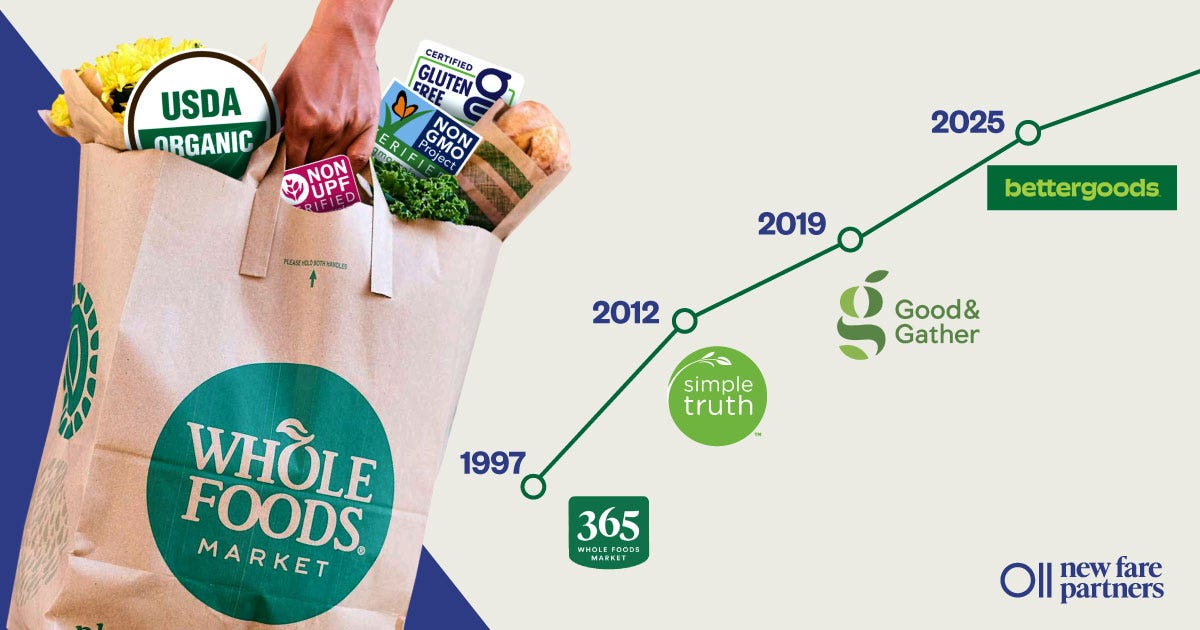
A big part of what I’m talking about - and the subject of Matt’s Bloomberg piece - is 365, the private label brand the retailer launched in 1997. It’s been such a slow and steady build, I don’t think Whole Foods’ gets a lot of credit for its contribution, and certainly hasn’t been handed what could be major recognition in redefining what private label is.
Whole Foods has played a major role in transforming store brands from a strategy rooted in price into one rooted in standards, trust, and retailer identity.
Today, private labels are no longer just a cheaper alternative to national brands. Increasingly, it’s become a mixed melody of ingredient standards, sourcing philosophy, branding, pricing, and consumer trust. A retailer’s own brand has become an expression of their food philosophy. That’s a very different proposition than the generic black-and-white cans that once defined the category. And, consumers are responding favorably with 72% saying private label is a strong alternative to branded products.
Just look at the reach of store brands today. U.S. private label sales reached a record $282.8 billion in 2025, according to PLMA. Store brand dollar sales increased nearly three times the rate of national brands, climbing 3.3% compared to just 1.2% for branded products during the 52 weeks ending December 28, 2025.
The outperformance becomes even more interesting when you look at what these brands represent. Target has launched almost 50 private label brands, including Good & Gather, which generates over $4B in annual sales and promises products without artificial colors, flavors or sweeteners to name a few while offering an expansive organic assortment. Kroger’s Simple Truth, launched in 2012, and has grown into the retailer’s second largest brand, one excluding more than 100 artificial ingredients. Albertsons’ O Organics, introduced in 2005, brought certified organic products to the mass market then later introduced more exacting standards around ingredient quality.
Beyond the largest national retailers, you’ve got independent grocers around the country taking advantage of this newfound respect for private label. As of 2025, 60% of shoppers trust store brands and 71% prefer them to national brands (to borrow from an earlier Substack I wrote on the subject). The house brands winning today look like brands in the traditional sense - beautifully designed, thoughtfully merchandised - and come with promises around ingredients, sourcing, and nutrition that would have been out of the question on a conventional grocery shelf twenty years ago. That philosophy has extended beyond supermarkets to retailers and e-grocers like Erewhon and Farm to People, Foxtrot, and even fast casual chains like Pura Vida.
To understand why Whole Foods is distinctive here, it’s worth looking at what made 365 different from the beginning.
The brand wasn’t built first and then wrapped in marketing language about quality. It was built on top of the chain’s Quality Standards - a list of hundreds of ingredients prohibited from the retailer’s shelves. In fact, in 2020 during the redesign of Whole Foods Market’s private label they dropped the tagline “Everyday Value”, signifying a shift in what their store brands were meant to convey. That’s still what separates Whole Foods from much of the field today.
Many retailers have borrowed pieces of the playbook: a prohibited ingredient list (albeit much more limited), integrating organics, cleaner packaging, modern branding. For Whole Foods, their quality philosophy is the brand; 365 was always meant to suggest you could still eat well, affordably.
Over the past two decades, Whole Foods has steadily expanded 365 in an effort to shed the “Whole Paycheck” reputation, first through pantry staples and increasingly across nearly every department. By most accounts, and according to Day’s Bloomberg piece, they’ve been successful; I rarely hear anyone use the nickname anymore.
In the process, though, they accomplished something much bigger than improving value perception. They helped lay the foundation for private label to become something consumers now actively seek out (71% of consumers choose their preferred retailer because of its private brand) - a signal of quality rather than compromise, of standards rather than savings alone.
Even if Whole Foods has lost some of its footing around local selection and the in-store experience, it continues to shape how other retailers set standards and curate their assortments. Today, its greatest influence isn’t what happens inside its stores, but the playbook it wrote for the rest of the industry - private label and otherwise.
Thanks for all this helpful background!! The tradeoff, to me, seems to be that it requires a tremendous amount of trust in the retailer and its sourcing, since so much of the product's story and other helpful information is essentially erased in the process.
I'm so curious to know: what do you think of TJ's approach to its private label program?
Truth!